Login to access
Want to subscribe?
This article is part of: Network Innovation
To find out more about how to join or access this report please contact us
The term ‘photonics’ is becoming more common than ‘optical’. But what does it mean for telcos? Does it suggest new opportunities?
Explainer: Photonics vs optical
The optical and photonics sector can be opaque to many participants in the broader telecoms sector. Just as cellular networks bring a host of acronyms, technical complexity and regulatory language, the terminology used in the photonics sector is often inaccessible to those not deeply immersed in it.
At the most basic level, the key point to recognise is that ‘optical networking’ is a sub-sector of the broader sector of photonics:
- Optical networking is the use of light to carry communications traffic through fibre networks. Transceivers are the basic components that transmit and receive light over a fibre and convert optical signals to electrical ones.
- Photonics is the broader technology domain, including generating, guiding, modulating, switching and detecting light. It includes optical networking, photonic chips, lasers, sensing, quantum components, packaging, optical computing and other applications.
In normal telecom usage, ‘optical’ usually describes a network, system, link or discrete physical product. Conversely, ‘photonic’ refers to the underlying devices, components or technology platform.
An (imperfect) wireless analogy is helpful for some newcomers. Optical networking is comparable to talking about radio access networks (RANs), microwave point-to-point links and services based on mobile-allocated spectrum bands. Photonics translates to the wider radio frequency (RF) technology domain, including the antenna, amplifiers and signal-processing ‘front end’ stack that enables wireless networks to work.
Telecom-relevant photonics and adjacencies
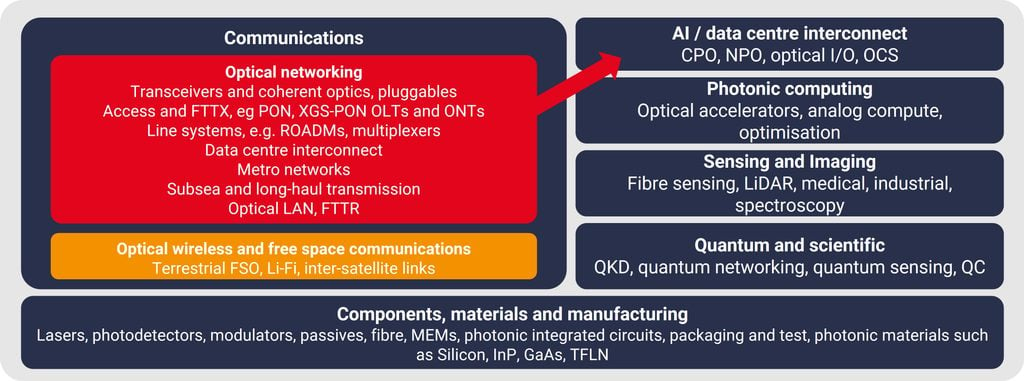
Source: STL Partners
If you are not a subscriber, enter your details below to download an extract of this report.
What has changed?
Telecom networks once underpinned the defining use cases for optical communications. Carrier networks are needed to transmit large volumes of data both in local broadband access markets and over longer distances. They had requirements to replace or substitute copper with lower capex and opex, higher reliability, and (often) vendor interoperability. In many cases, policy or regulatory objectives have explicitly driven fibre. Investors viewed fibre route-miles or homes passed as key metrics for funding.
That, in turn, drove progress in standardisation and technological developments such as single-mode fibre, DWDM, optical amplification, coherent transmission, ROADMs and PON.
The AI data centre era of photonics starts from different perspectives. How many GPUs or accelerators can be connected to form one useful computing system? How much bandwidth can a switch or processor package transmit? How much power does each transceiver replaced by CPO save? Can a photonic fabric support new AI traffic patterns, rather than ordinary ‘north-south’ client-server data flows over a network? The resulting priorities include 200G over copper, 800G and 1.6T pluggable optical modules, CPO, NPO and OCS.
These technologies overlap with telecom-grade optics, but are not simply faster versions of carrier equipment. Their buyers, distance targets, operating environments and replacement cycles differ. The most important R&D customer may now be a hyperscaler, a GPU vendor or a switching processor supplier. It is not clear that everyone in telcos has yet recognised their lower rung on the new photonic ladder of priorities.