Case study overview
STL Partners worked with a major UK telecoms provider to support the development of its UK Network-as-a-Service proposition. The client wanted to understand how the UK NaaS market is evolving, and how to tailor their solution and sales strategy to capture market demand.
STL supported the client to:
- Identify the main players in the UK NaaS market and undertake a deep assessment of their propositions, platforms and CX offering
- Understand the expectations of priority customer segments across enterprise, public sector, SMB and wholesale audiences to support product development and roadmap
- Identify actionable recommendations for its NaaS solution across digital experiences, sales approach, commercial model and customer migration support
What was the approach?
STL Partners delivered this engagement across five connected workstreams, designed to build from market understanding through to proposition and lifecycle recommendations.
1. Market scan and alignment
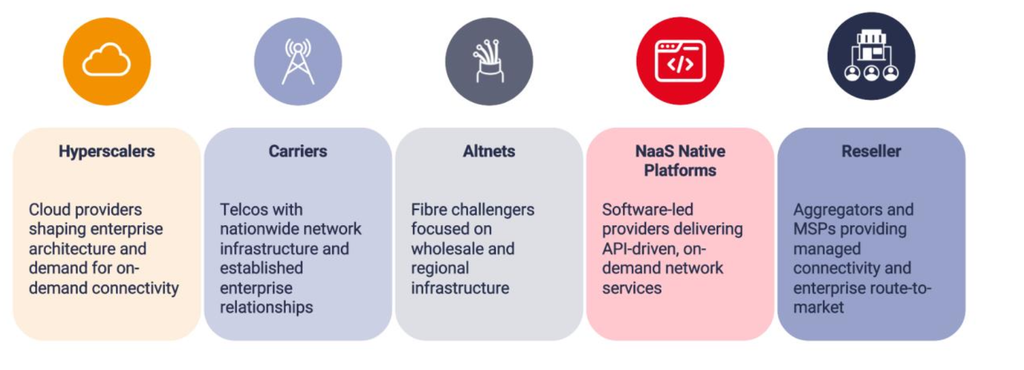
We established a shared view of the UK NaaS market landscape, including market maturity, customer readiness, emerging trends and competitive positioning. This included identifying the main UK NaaS and NaaS-adjacent players and conducting detailed benchmarking exercise.
2. Digital experience and platform insights
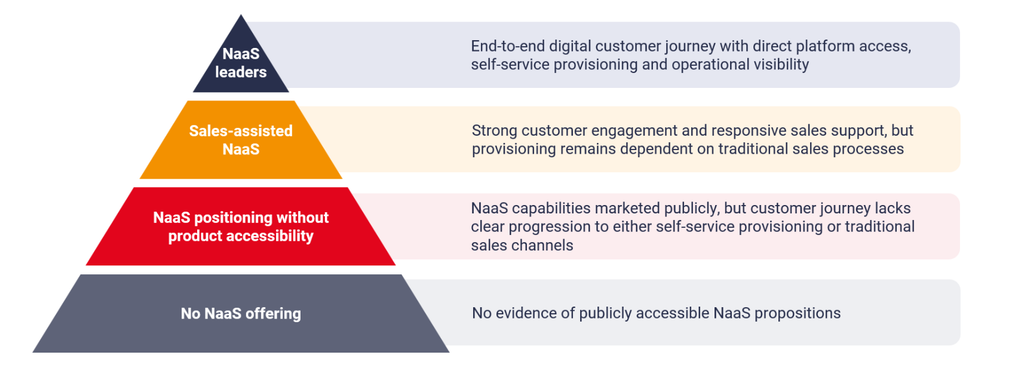
We used mystery shopping and customer experience assessment frameworks to evaluate competitor digital experiences, understanding how leading and emerging NaaS players support customer journeys across quoting, ordering, provisioning, monitoring and in-life management. This identified the strengths and weaknesses of competitor solutions, informing CX and design recommendations for the client’s proposition.
3. Segment-specific needs and requirements
We explored customer needs across priority segments, including wholesale, corporate and public sector. Through qualitative interviews and quantitative survey design, the workstream identified adoption readiness, pain points, preferred commercial models, digital experience expectations and appetite for different levels of self-service, portal access, and API integration.
4. Migration principles
We developed migration scenarios aligned to different segment needs. This workstream considered how customers might move from legacy connectivity estates towards NaaS-like models, what friction points could slow adoption, and which commercial, operational or support mechanisms can support customer transition.
5. Strategic synthesis and lifecycle design
We synthesised the workstream findings into lifecycle maps and strategic recommendations. This included mapping pain points and expectations across the customer lifecycle, defining where customers would expect digital tooling, APIs, human support or account management, and setting out the implications for proposition design, sales, customer experience and migration planning.
Key results from the project
- A clear view of its competitive position in the UK NaaS market, distinguishing where it stands against platform-led providers versus traditional connectivity providers with partial NaaS capabilities
- A precise understanding of its primary target customers, their pain points, connectivity requirements and self-service appetite, translated into actionable product and sales recommendations
- Clarity on where to prioritise investment across portal, API, automation and account-led support capabilities, directly shaping the product development roadmap
- A practical blueprint for how to position the solution, spanning proposition, commercial, sales, digital experience and migration support