Case study overview
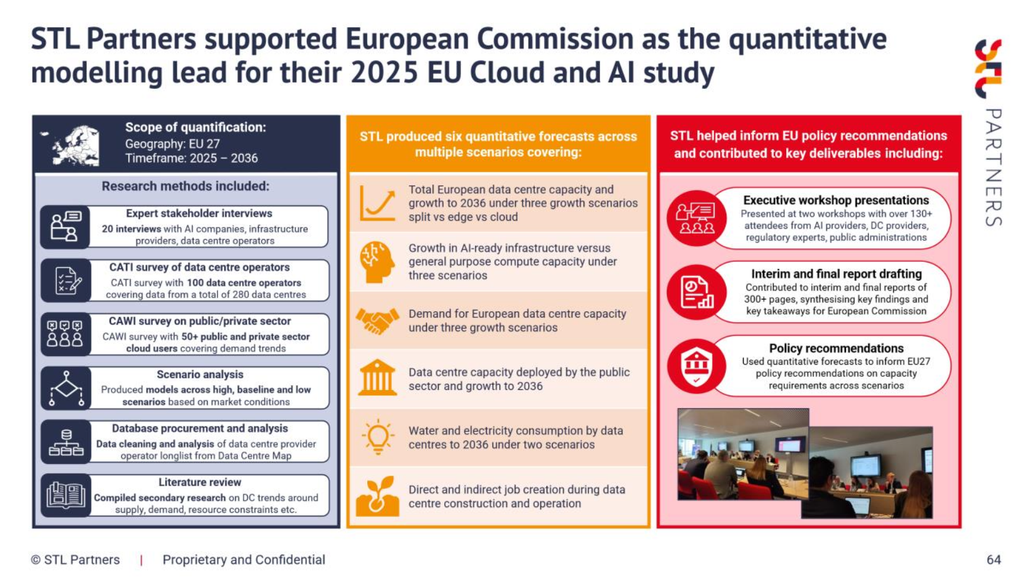
STL Partners was the quantitative modelling lead for the European Commission’s 2025 study into the future of cloud and AI infrastructure across the EU27. The work gave the Commission an independent, evidence-based view of how data centre capacity, demand and resource use will develop to 2036, informing European digital-infrastructure policy.
The engagement combined expert interviews and surveys of data centre operators and public- and private-sector cloud users with bottom-up capacity modelling and multi-scenario forecasting. STL synthesised the findings into six quantitative forecasts to inform future EU27 policy recommendations.
What was the approach?
STL designed and ran a comprehensive three-part programme that spanned primary research, quantitative modelling and forecasting, and the development of policy recommendations and final deliverables.
- Evidence base and primary research
- Expert stakeholder interviews: conducted 20 in-depth interviews with a broad cross-section of AI companies, infrastructure providers and data centre operators to capture first-hand market insight and validate emerging assumptions
- CATI survey of data centre operators ran a computer-assisted telephone interviewing (CATI) survey of 100 data centre operators, gathering detailed data covering a total of 280 data centres across the EU27
- CAWI survey on the public and private sector: completed a computer-assisted web interviewing (CAWI) survey of more than 50 public- and private-sector cloud users to map current and anticipated demand trends
- Scenario analysis: developed models across high, baseline and low scenarios, each reflecting a distinct set of assumptions about future market conditions
- Database procurement and analysis: procured, cleaned and analysed a comprehensive longlist of data centre providers and operators sourced from Data Centre Map to underpin the capacity model
- Literature review: carried out extensive secondary research on data centre trends spanning supply, demand and resource constraints to contextualise the primary findings
- Quantitative modelling and forecasts
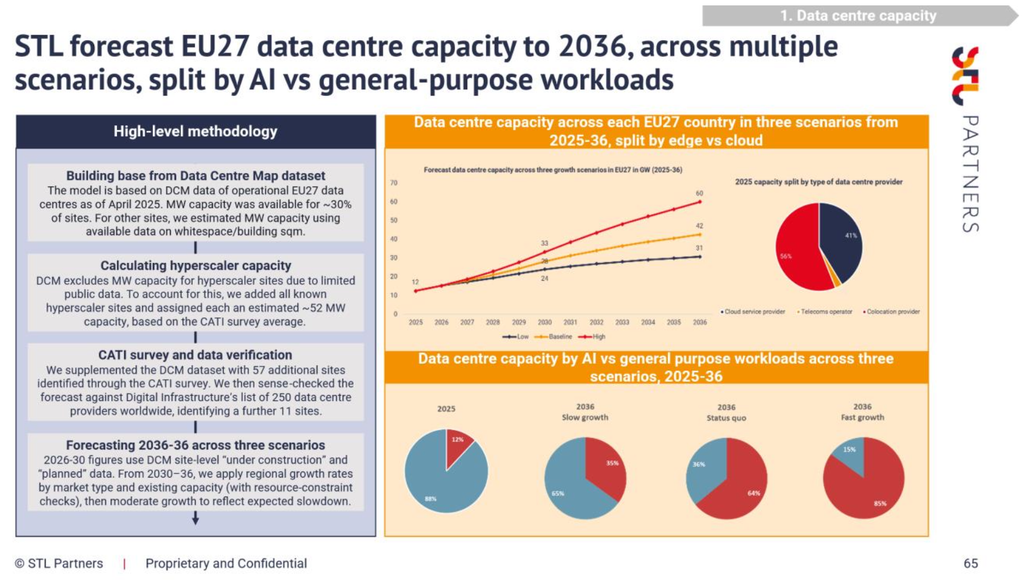
- Total European data centre capacity and its projected growth to 2036 under three distinct growth scenarios, disaggregated by edge versus cloud deployment
- Growth in AI-ready infrastructure compared with general-purpose compute capacity, modelled across the same three scenarios to highlight the shifting balance between the two
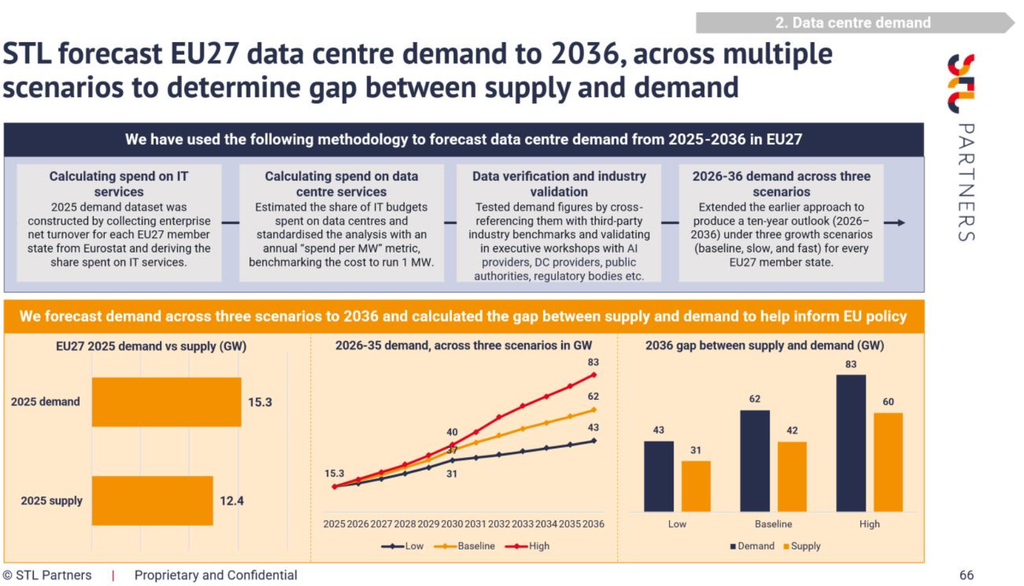
- Projected demand for European data centre capacity under three growth scenarios, providing a demand-side counterpart to the capacity forecasts
- Data centre capacity deployed specifically by the public sector, together with its anticipated growth trajectory to 2036
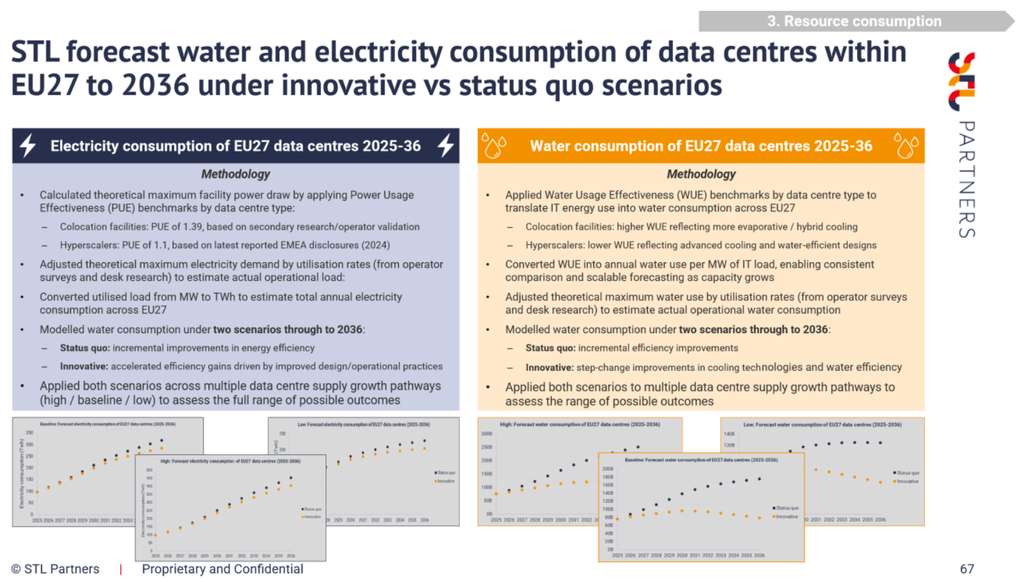
- Water and electricity consumption by data centres through to 2036, modelled under two efficiency scenarios to capture the range of potential resource use
- Direct and indirect job creation generated during both the construction and the ongoing operation of data centres
- EU policy recommendations and deliverable production
- Executive workshop presentations: presented at two workshops with 130+ attendees from AI providers, data centre providers, regulatory experts and public administrations
- Interim and final report drafting: contributed to interim and final reports totalling 300+ pages, synthesising key findings for the European Commission
- Policy recommendations: used the quantitative forecasts to inform EU27 policy recommendations on capacity requirements across scenarios
Key results from the project
- Delivered six quantitative forecasts of EU27 data centre capacity, demand, AI vs general-purpose split, public-sector capacity, resource use and jobs, each modelled across multiple scenarios to 2036
- Built and verified a bottom-up EU27 capacity model, drawing on a CATI survey of 100 operators covering 280 data centres
- Grounded demand assumptions in 20 expert interviews and a CAWI survey of 50+ public- and private-sector cloud users
- Modelled electricity and water consumption to 2036 under status-quo and innovative efficiency scenarios, across high, baseline and low supply pathways
- Informed EU27 policy recommendations, presenting at two executive workshops with 130+ attendees and contributing to interim and final reports
Scope of quantification
- Geography: EU27
- Timeframe: 2025–2036