
Download
Listen


This article is based on a February 2026 discussion with Professor Rajiv Ranjan, Director of the National Edge AI Hub. It explores the Hub’s origins and ambitions, looking at how its network of university and industry partners is supporting organisations deploy real-time AI in the physical world.
What is the National Edge AI Hub?
The National Edge AI Hub is a UK wide research and innovation consortium providing solutions and support for edge AI, centred on making artificial intelligence at the edge safe, resilient and trustworthy. The Hub was launched in early 2024 and is one of nine research Hubs set up across the UK to deliver next-generation AI technologies. It is funded by an £12 million investment from the Engineering and Physical Sciences Research Council (EPSRC), a government-funded research council that forms part of the UK Research and Innovation (UKRI). The National Edge AI Hub brings together 15 universities, each selected for distinct expertise and testbed infrastructure. This enables companies and public sector organisations to access the specialist skills necessary for the deployment of edge AI through a single national network, rather than building these capabilities in-house. Though the Hub’s primary focus is edge AI in the UK and supporting UK companies, it is also building partnerships beyond Europe, with particular interest in Asia and the Middle East due to the scale of AI investment in those regions.
The National Edge AI Hub university ecosystem
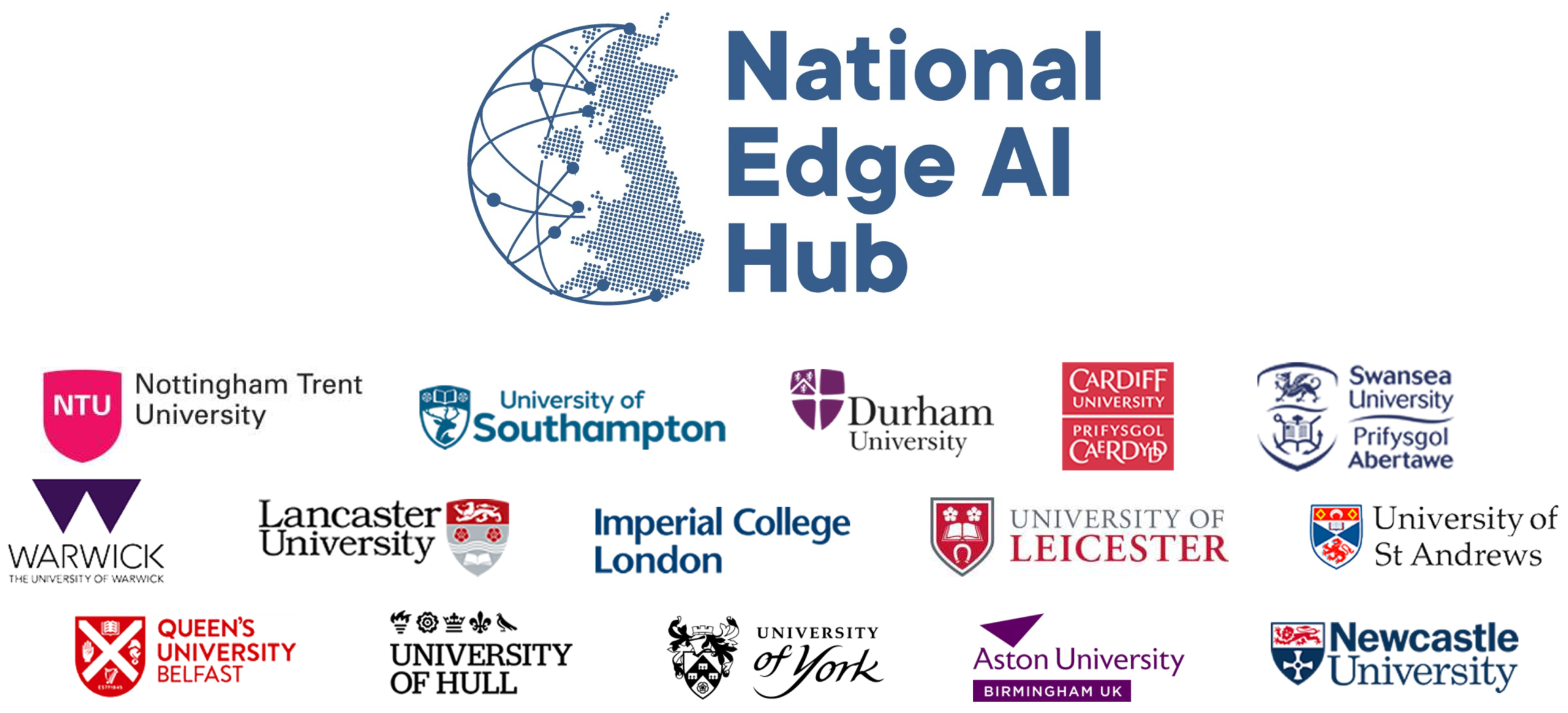
Source: The National Edge AI Hub
How was the Hub founded?
The story starts with the founding of Newcastle’s Urban Observatory in 2015, where thousands of sensors were deployed across Newcastle and the North East area to collect real-time data. This work highlighted the misalignment between collecting and storing data in the cloud and actually creating responsive, real-time applications from it. In 2017, the team developed the idea of osmotic computing, a way of thinking about how computing can move to where data is generated and then move back to the cloud when needed for heavier analysis. This became an early foundation for working across the edge cloud continuum.
From there, the research widened into security and resilience questions, including how to protect systems such as EV charging stations from cyberattacks. By 2021, it was clear that these challenges were not confined to one niche use case. Similar issues appeared across domains such as manufacturing and healthcare, prompting the team to bring together leading UK research groups into a national initiative designed to help organisations deploy edge AI safely and effectively. And, thus, the edge AI Hub was founded in early 2024.
What is edge AI?
In the Hub’s framing, edge AI encompasses AI deployed outside the security perimeter of a cloud data centre or enterprise data centre environment. This primarily concerns the deployment of AI on-devices and in physical systems like phones, cameras, buildings, vehicles and drones.
A key nuance is that edge AI often relies on cloud support for orchestration and remote control. The intelligence may sit at the extreme edge, but the lifecycle of deployment, monitoring and updates typically includes cloud coordination.
What is the Hub’s relationship with UK universities?
The Hub is structured as a national network of university partners, with capability distributed across institutions based on what each does best. It maintains a resource catalogue so companies can be directed to the right facilities and expertise. For example, robotics capabilities may be strong in one institution, autonomous vehicle testing in another, and cybersecurity facilities elsewhere. The intent is not that every university builds holistic facilities. Instead, the Hub makes the UK stronger by pooling specialised assets and allowing partners to collaborate quickly when a project demands it. For example, York University has strong robotics lab expertise, Newcastle is celebrated for its smart city work, while Nottingham Trent has developed significant expertise in medical imaging.
This means that students are a core part of the Hub’s operating model. The Hub involves MSc and PhD students in industry projects, both to train them on live, current challenges and to connect them directly with employers. This creates a practical talent pathway, improving employability for graduates while helping companies access motivated developers and researchers with relevant experience. The Hub estimates that around 30 to 40 percent of its focus is on academic excellence and skills development, including efforts to build new training programmes in areas such as AI safety and AI security.
What are the most common obstacles for companies trying to deploy or scale edge AI?
The most common obstacles are cybersecurity, dependability, and safety, especially the question of whether an AI system can be trusted to make the right decision consistently when it is learning from real time data. The Hub contrasts older AI patterns, where models are typically trained on labelled data and updated periodically through supervised training, with newer self learning approaches that can adapt over time using new data and feedback with less direct human oversight.This creates understandable scepticism among companies who fear unintended learning and unsafe behaviour. This is one reason why the Hub emphasises safety-focused testing, aiming to identify extreme failure cases and define warning signals that developers and operators should monitor in deployment.
Common obstacles for enterprises deploying edge AI
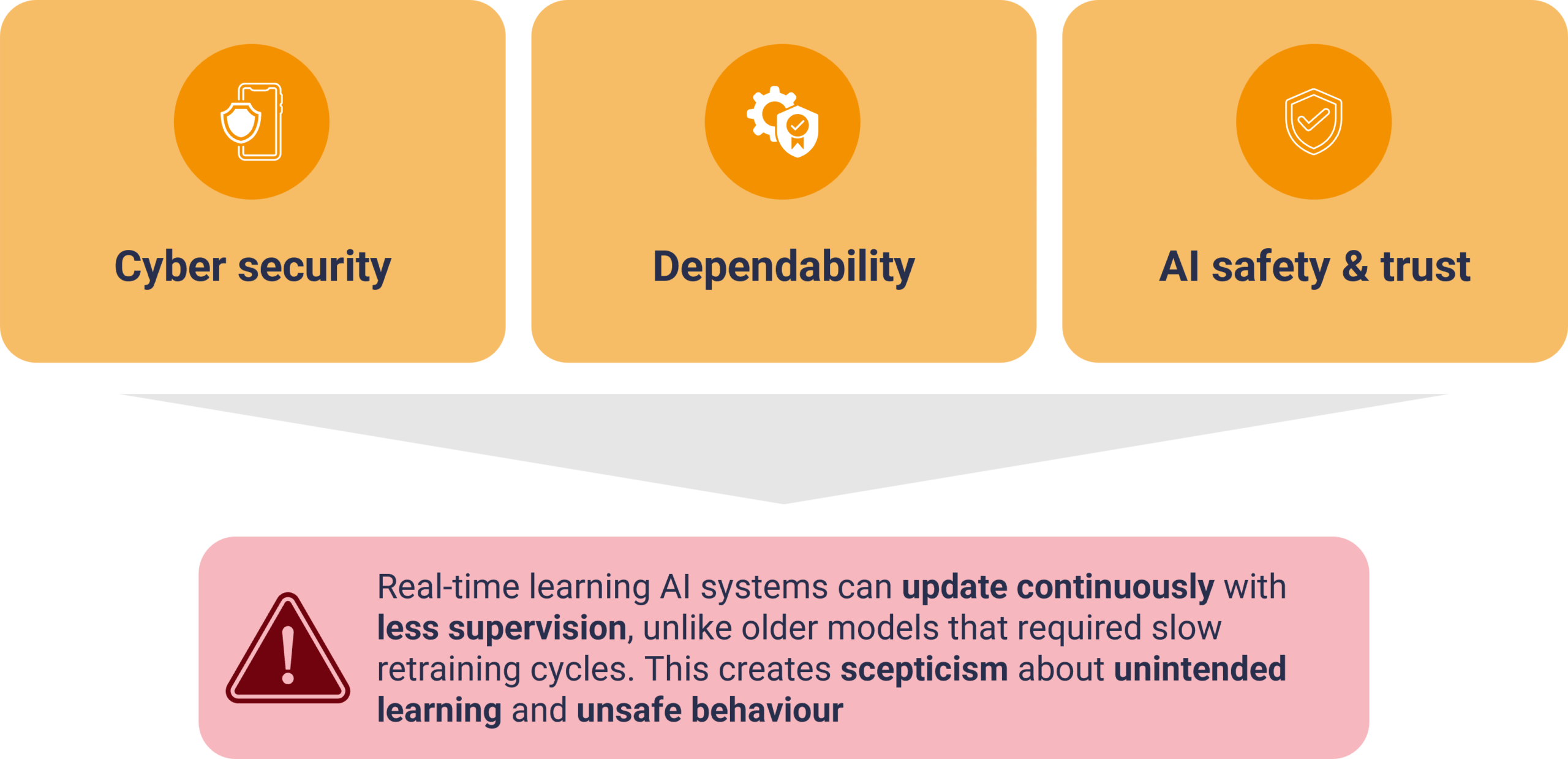
Source: STL Partners
How are AI models trained at the Hub?
At the Hub, the typical starting point is a foundation model that is then adapted for a given deployment context and dataset, rather than building everything from scratch. Open source plays a major role, both because it speeds up development and because it enables teams to focus on customisation and validation for specific use cases. Alongside this, the Hub works with the AI Safety Lab and with industry partners, where selected models can be sandboxed and tested to identify bugs and safety issues. At the same time, the consortium includes foundational AI researchers who can train baseline models or even alter underlying model methods when required.
What are the key edge AI drivers?
There are three key drivers for edge AI. Firstly, the need for real-time decision making, where latency and responsiveness matter and data is produced continuously in operational settings. Secondly, cybersecurity and resilience are also key, particularly for systems that affect safety, critical infrastructure, or business continuity. Thirdly, autonomy is crucial, and the need to enable physical systems to operate with less human intervention while remaining safe and dependable. This includes moving systems like drones and vehicles, where on-device sensing and inference are needed to act quickly and safely, and static systems like power grids, where decentralised monitoring can improve detection and response compared with purely centralised approaches.
Three key drivers of edge AI
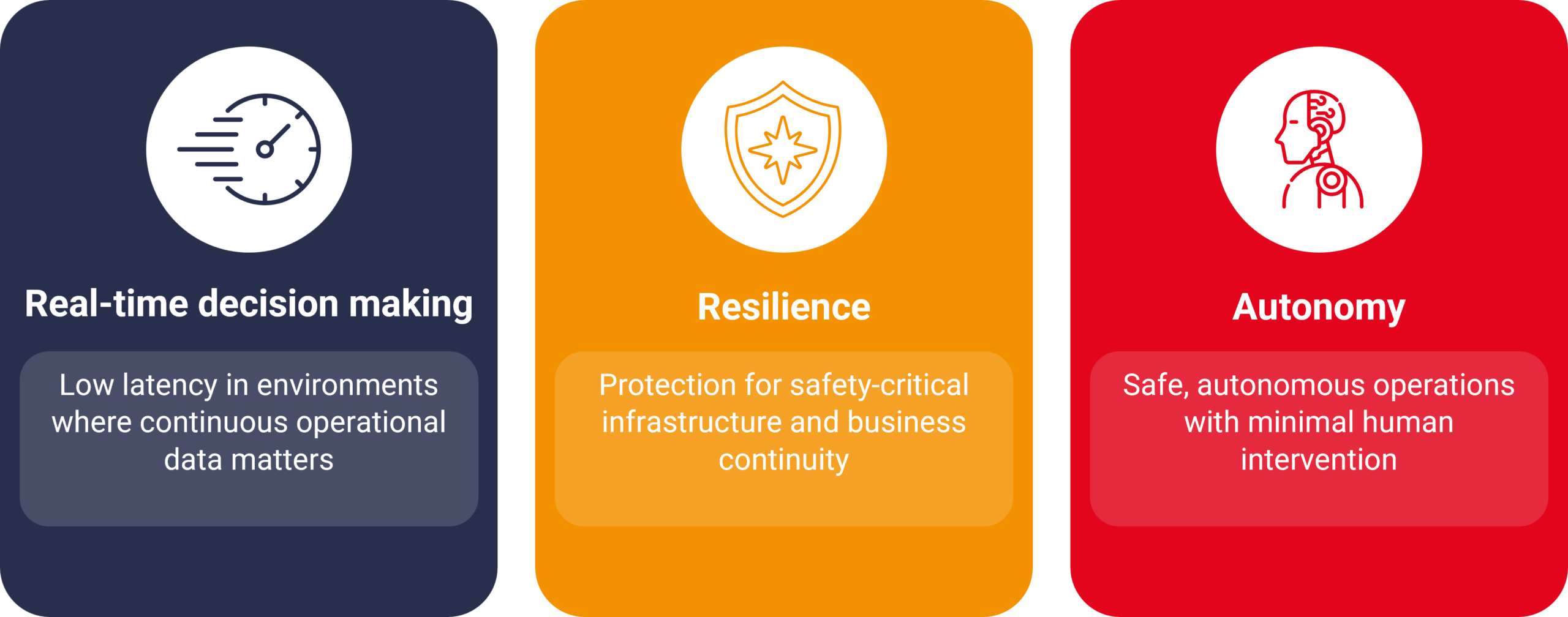
Source: STL Partners
How will the edge AI market develop over the next five years?
Edge AI demand will likely grow across a range of verticals, including defence, energy, aerospace, autonomous driving, healthcare, and even future connectivity contexts such as 6G. The Hub’s focus is framed more broadly, suggesting that many “smart” applications can fit within themes like transport, energy, and healthcare. The aim is to be deliberately flexible rather than tied to a narrow set of verticals. For example, a pertinent current topic is edge AI for real-time battery health monitoring in EV contexts, translating sensor data into actionable guidance for drivers and fleet operators.
For more information about the Edge AI visit: https://edgeaihub.co.uk/
Are you looking for advisory services in edge computing?
Download the Edge insights market overview
Download the Edge insights market overview
This 33-page document will provide you with a summary of our insights from our edge computing research and consulting work:

Edge computing at MWC 2025: AI is the trigger
Edge computing was present across the Fira this year, though not as the headline act. Instead, it appeared in its rightful place as a key enabler, deeply woven into the discourse surrounding AI monetisation.

From showcase to shelf: MWC Shanghai highlights how Chinese telcos monetise AI
three demos from China’s telcos at MWC Shanghai 2026 illustrate the different ways telcos are trying to build businesses around AI.

What the Mythos ban means for AI sovereignty
On 12 June 2026, the US ordered Anthropic to disable Claude Fable 5 and Mythos 5 for any foreign national worldwide. The directive turned the frontier model itself into a sovereignty question, not …

How AI can accelerate IT and OT convergence to transform customer experience
AI can play a central role in enabling convergence, acting as a unifying intelligence layer across IT and OT.