
Download
Listen


Quantum computing is gradually moving from the lab towards real infrastructure decisions. This article explores what quantum computing is, why it matters, and how it could reshape data centre design over time.
What is quantum computing?
For decades, computing has followed a simple rule: information is processed using bits that are either on or off, 1 or 0. Everything from spreadsheets to cloud platforms and AI models ultimately runs on vast numbers of these binary decisions, executed at extraordinary speed.
Quantum computing breaks that rule. Instead of bits, quantum computers use qubits, which follow the laws of quantum physics rather than classical electronics. These laws allow qubits to behave in ways that feel counter-intuitive from a conventional computing perspective. A qubit does not have to be strictly a 0 or a 1. It can exist in a combination of both at the same time, a property known as superposition.
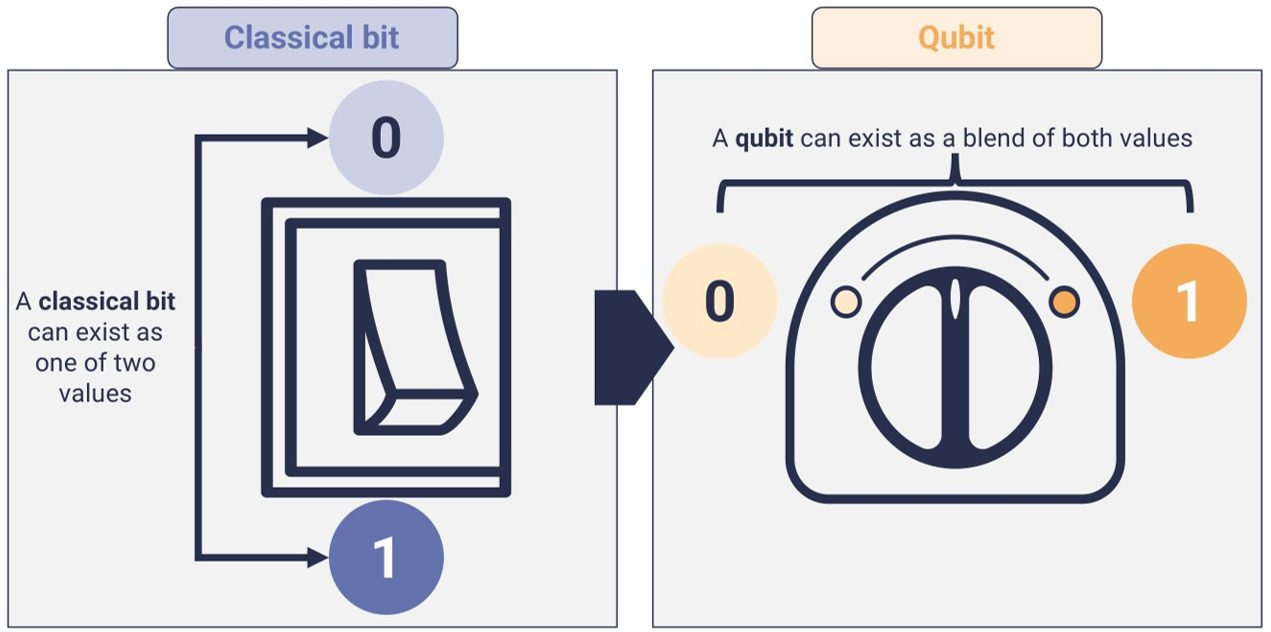
This does not mean that a quantum computer “tries every possible answer at once”, a common but misleading simplification. A quantum computer explores many possible states simultaneously, but it does so in a controlled way. As the calculation progresses, the different possibilities interact with one another. Because qubits behave like waves, these possibilities can combine constructively or destructively. Some paths reinforce each other, increasing their likelihood, while others interfere and effectively cancel out.
The goal of a quantum algorithm is to design this pattern of interference so that the probability of measuring a correct answer becomes high, and the probability of measuring an incorrect one becomes low. When the system is finally measured, it does not reveal every possible solution. It reveals a single outcome – but one that has been deliberately amplified by the structure of the computation.
In other words, quantum computers do not brute-force every answer in parallel. They reshape the problem so that the right answer becomes more likely to emerge. The practical consequence is that quantum computers approach problems in a fundamentally different way, rather than simply performing the same calculations faster.
Why is there excitement around quantum computing?
The excitement around quantum computing does not come from speed alone. It comes from the possibility of solving certain problems that today’s computers struggle with, even when scaled to enormous size.
Modern data centres already contain some of the most powerful machines ever built. Yet there are classes of problems where adding more servers, more GPUs, or more energy produces diminishing returns. Quantum computing is exciting because it offers a different approach, not just a bigger one.
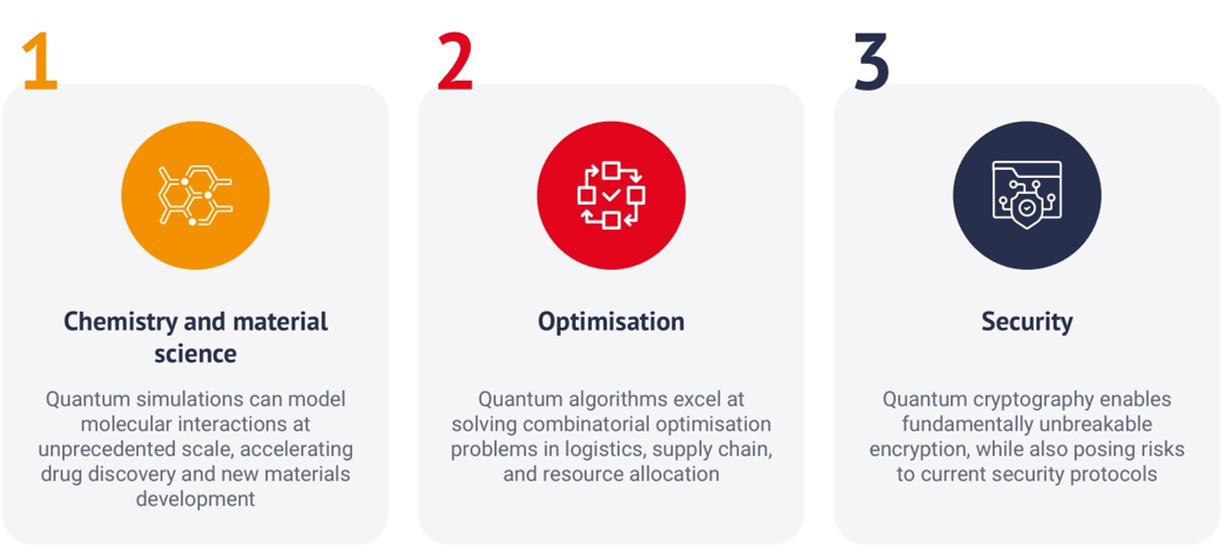
Broadly speaking, are three main domains where quantum is currently speculated to have a substantive impact based on its unique capabilities and characteristics:
- Chemistry and material science
- Optimisation of complex workflows
- Security
Chemistry and material science
One of the most compelling areas is chemistry and material science. At a fundamental level, molecules and materials are governed by quantum mechanics. Electrons interact in complex, probabilistic ways that are difficult for classical computers to represent accurately. As systems grow larger, the computational effort needed to model them increases dramatically.
Quantum computers, by contrast, operate using the same underlying rules as the systems they are trying to simulate. This makes them potentially far better suited to modelling chemical reactions, discovering new materials, or understanding complex molecular behaviour. If successful, this could accelerate advances in areas such as drug discovery, energy storage, fertilisers, and advanced manufacturing.
Optimisation
Another source of excitement lies in complex optimisation problems. Many real-world challenges – from logistics and supply chains to financial portfolios and energy networks – involve finding the best solution among an enormous number of possible combinations. Classical computers can tackle these problems, but they often rely on approximations and heuristics to keep computation tractable.
Quantum approaches may help explore these solution spaces more efficiently, particularly when combined with classical computing in hybrid workflows. While this is not a guaranteed breakthrough, even incremental improvements could have significant economic and operational impact in certain industries.
Security
Security is a third driver of interest, and a more immediate one. Some of today’s most widely used encryption methods rely on mathematical problems that are extremely hard for classical computers to solve. A sufficiently powerful quantum computer could, in principle, solve these problems much faster, undermining existing cryptographic systems.
This does not mean quantum computers are already breaking encryption. They are not. But it does mean that data encrypted today could be vulnerable in the future – a risk often described as “harvest now, decrypt later”. As a result, governments and enterprises are already preparing for a post-quantum world by developing and adopting new cryptographic standards designed to withstand quantum attacks.
The excitement, then, is focused and strategic. Quantum computing is exciting not because it will change everything, but because it could change a small number of extremely important things – and because those changes would be impossible to achieve by scaling classical computing alone.
The problem of building quantum computing
If quantum computing is so promising, a natural question follows: why isn’t it already widespread? The answer is simple in principle: quantum systems are extraordinarily fragile.
Qubits only work as intended when they are kept in a very precise state. Any unwanted interaction with the outside world – heat, vibration, electromagnetic noise, or even tiny imperfections in control signals – can disturb that state and introduce errors. This process, known as decoherence, happens far more easily than most people expect. In everyday computing, noise and minor imperfections are routine. Classical systems are designed to tolerate them through redundancy and error checking. Quantum systems, however, are far less forgiving. A small disturbance that would be irrelevant in a classical processor can completely invalidate a quantum calculation.
This fragility means that quantum computers must operate in extreme conditions. Many leading systems are cooled to temperatures close to absolute zero to prevent thermal energy from disrupting qubits. Others rely on ultra-high vacuum chambers or highly stable laser systems. In all cases, the surrounding environment must be carefully controlled. Even under these conditions, errors are unavoidable. Today’s quantum computers make mistakes frequently, limiting how long and how complex their calculations can be. This is why most current machines are described as noisy in the statistical sense of the word: they can demonstrate quantum behaviour, but not sustain it reliably over long computations.
The long-term solution is quantum error correction. Instead of relying on a single qubit, many physical qubits are combined to form one more reliable “logical” qubit. Errors are detected and corrected continuously, while the computation is running. In theory, this allows quantum calculations to scale. In practice, it introduces enormous overhead. A single logical qubit may require dozens, hundreds, or even thousands of physical qubits, depending on the technology and error rates involved. This dramatically increases the size, complexity, and cost of quantum systems.
Scaling also exposes other challenges. As quantum computers grow, they require more control electronics, more wiring, more cooling, and more precise synchronisation. The physical effort of connecting, controlling, and shielding large numbers of qubits quickly becomes a systems-engineering problem, not just a physics one. As a result, progress in quantum computing is incremental rather than explosive. Researchers and companies are steadily improving qubit quality, error rates, and system integration, but each advance reveals new engineering constraints.
This is why quantum computing remains largely confined to laboratories and highly specialised facilities.
Building a quantum computer is not just about designing a better chip; it is about mastering an entire stack of physics, hardware, software, and environmental control. This is often at the very limits of what current engineering can support.
The concept of a quantum data centre
Given how fragile and complex quantum computers are, it quickly becomes clear that they cannot simply be installed in a standard server rack. This is where the concept of a quantum data centre emerges.
At its simplest, a quantum data centre is a facility designed to host quantum computers alongside the extensive infrastructure they require. It is not a warehouse filled with quantum chips. Instead, it is a hybrid environment that combines highly specialised equipment with more conventional computing systems. A useful way to think about it is this: in today’s AI data centres, the standout element is the GPU server, but behind it sits a vast ecosystem of power distribution, cooling, networking, orchestration software, and operational management. In quantum computing, the imbalance is even more pronounced. The itself may be physically small, but the surrounding systems are very large, very complex, and very critical.
A quantum processor is the physical device that creates and controls qubits, the basic units of quantum information. Unlike classical processors built from billions of silicon transistors, quantum processors are made from carefully engineered physical systems that exhibit quantum behaviour. Depending on the technology, qubits may be formed from superconducting circuits on a chip cooled close to absolute zero, individual atoms trapped in electromagnetic fields or laser arrays, or particles of light guided through photonic circuits. In every case, the processor itself is only part of the system, surrounded by complex control electronics, cooling or vacuum infrastructure, and classical computers that manage and interpret the computation.
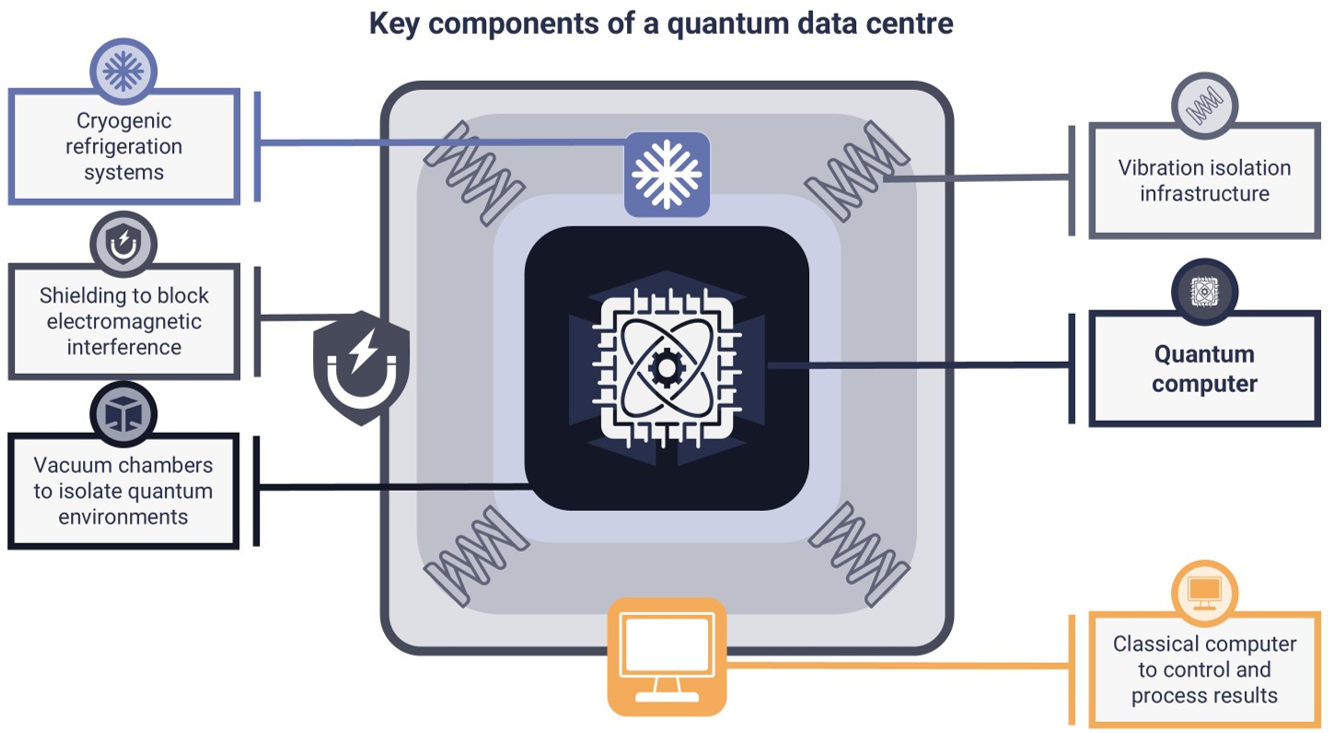
As mentioned previously, there are several routes to developing quantum technologies, meaning there is no singular reference architecture for how quantum data centres might develop. That being said, there are several potential architectural features which quantum data centres may incorporate.
- Cryogenic refrigeration systems operating near absolute zero
- Vacuum chambers or laser control systems to isolate quantum environments
- Shielding to block electromagnetic interference
- Vibration isolation infrastructure
- Classical computers to control, read out, and process results
It is also important to note that there is no single blueprint yet. Different quantum technologies have very different environmental requirements. Some demand extreme cryogenic systems; others rely more heavily on lasers and optical components. As a result, quantum data centres today are highly customised, and standardisation remains .
From an current infrastructure perspective, today’s leading quantum systems would not slot neatly into a standard high-density data hall. Superconducting quantum computers, for example, are housed inside large dilution refrigerators that can stand several metres tall and weigh several tonnes once fully assembled. They require dedicated cryogenic plant, vibration isolation, and careful electromagnetic shielding. The quantum chip itself consumes little power, but the surrounding cooling systems, compressors, and control electronics can be energy intensive. As a result, quantum installations are less about rack power density and more about specialised mechanical and environmental engineering. In most cases, this suggests dedicated rooms or structurally assessed areas rather than simple placement within conventional server rows, particularly as systems scale.
Conclusion
Quantum data centres are unlikely to replace conventional facilities, but they may become a specialised and high value extension of advanced computing infrastructure. As quantum systems mature, particularly if fault tolerance is achieved, they are likely to sit alongside AI and HPC as tightly integrated accelerators for specific, high impact workloads. The shift will be gradual and technology dependent, but it represents a genuine new frontier in infrastructure design.
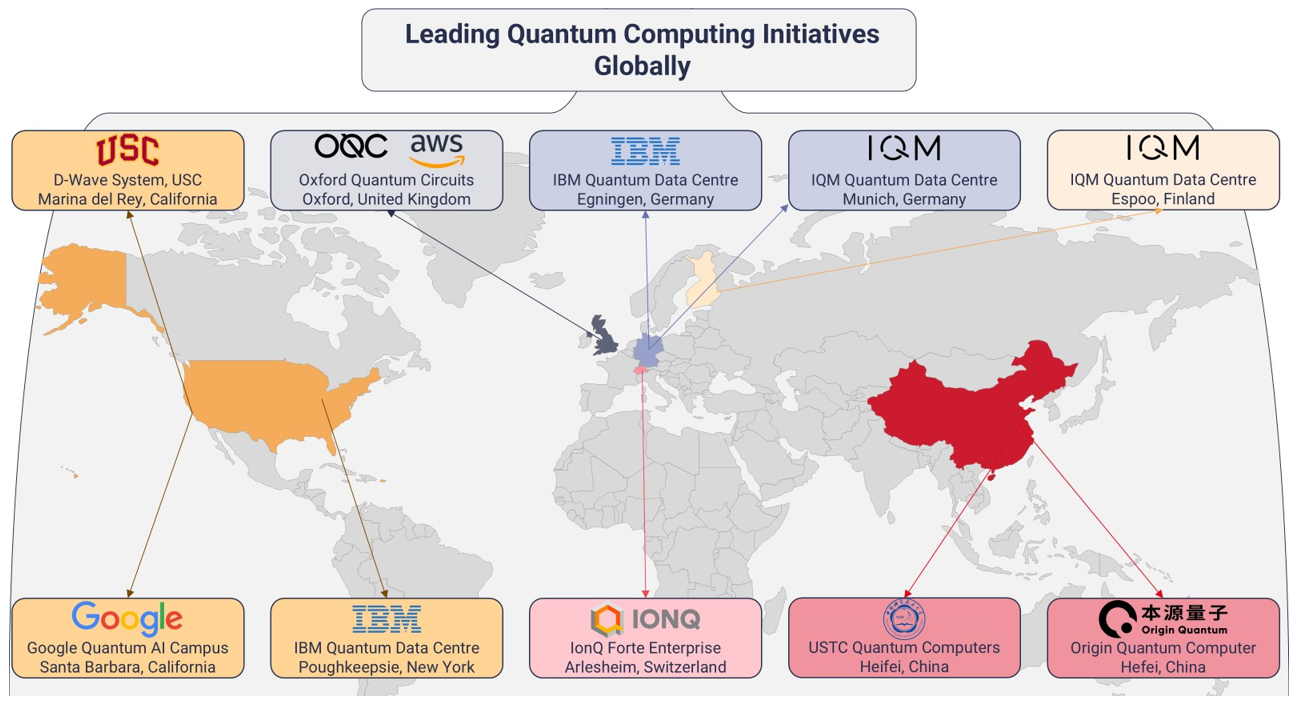
For operators and investors, the priority today is not large-scale deployment but strategic positioning. That means building early partnerships with quantum vendors, academia and research labs to understand technical requirements, assessing whether existing facilities could support future quantum installations without overcommitting capital, and focusing on hybrid integration with AI and HPC rather than standalone quantum hosting. With no clear winning technology yet, flexibility and ecosystem proximity matter more than picking a hardware champion. As seen in moves by players such as Digital Realty partnering with Oxford Quantum Circuits and NVIDIA integrating quantum workflows with accelerated computing, the advantage lies in gaining early operational insight and optionality rather than waiting for full market maturity.
This is exactly the kind of inflection point STL Partners focuses on, analysing emerging compute paradigms, infrastructure models and ecosystem shifts early, so stakeholders can position themselves at the leading edge rather than reacting once the market has already moved.
Looking for advisory services in data centres? Schedule a call.
Download the data centre insights overview pack
Download the data centre insights overview pack
Get a concise, practical summary of the data centre market: the impact of AI and sovereign strategies, the differentiators that win in a crowded landscape, and proven frameworks for market entry, channel partnerships and customer acquisition—backed by case studies and sample deliverables.
Can orbital data centres overcome terrestrial constraints?
Power and land constraints are prompting novel approaches to data centre construction, notably orbital data centres.

Five things we learned at Datacloud Global Congress 2026
We were at Data Cloud Congress 2026 in Cannes last week to evaluate the key narratives among data centre operators, investors and vendors.

The hidden economics of liquid-cooled data centre retrofits
This article, kindly supported by Airedale, explores when liquid cooling retrofits make commercial sense, showing why the decision depends on HPC pricing, facility fill, market constraints and disciplined execution.
Five things we learned at Datacloud Global Congress 2026
We were at Data Cloud Congress 2026 in Cannes last week to evaluate the key narratives among data centre operators, investors and vendors.

Key takeaways from the launch of the Quantum Infrastructure Council
STL Partners attended the launch of QIC to explore what it will take to deploy
quantum technologies in real-world data-centre environments.

The EU’s AI Gigafactory Initiative: What it means for digital infrastructure?
The EU’s €20 billion AI gigafactory initiative will fund up to five large-scale AI compute facilities, each designed to support frontier model training with more than 100,000 advanced AI processors.