Login to access
Want to subscribe?
This article is part of: Enterprise Platforms
To find out more about how to join or access this report please contact us
This report builds on our Network API monetisation forecast, examining five telco location APIs across anti-fraud, marketing and Industry 4.0 use cases. It sets out how telcos can win developers on consumability, privacy and partnering.
Use cases for location data have typically been segregated by the need for granularity and/or data velocity. In this research, we explore the opportunity for telco location APIs in three use case categories:
- Real-time precision: Served today by GPS and device location, for example by Google Maps which charges ~USD7 per 1,000 calls. It is accurate to 1m–10m and relatively cheap, but needs an app the user has opted into, adding friction to the UX for B2C use cases. In B2B, GPS chips add cost and drain batteries on IoT devices.
- Trusted verification (except IoT): Served today by IP geolocation and nearly free at flat fees of ~USD500/month for unlimited calls. It is accurate only to ~1 km and easy to spoof, but good enough for most fraud and onboarding checks, so buyers need convincing to pay more. However it is not useful for IoT use cases.
- Historic analytics: The one quadrant telcos already own and commercialised through consultative sales. It needs movement patterns over time, not a single snapshot, and only operators hold that history for their subscribers. But volumes are smaller so as-a-service pricing is not as commercially interesting.
Categorisation of location API use cases
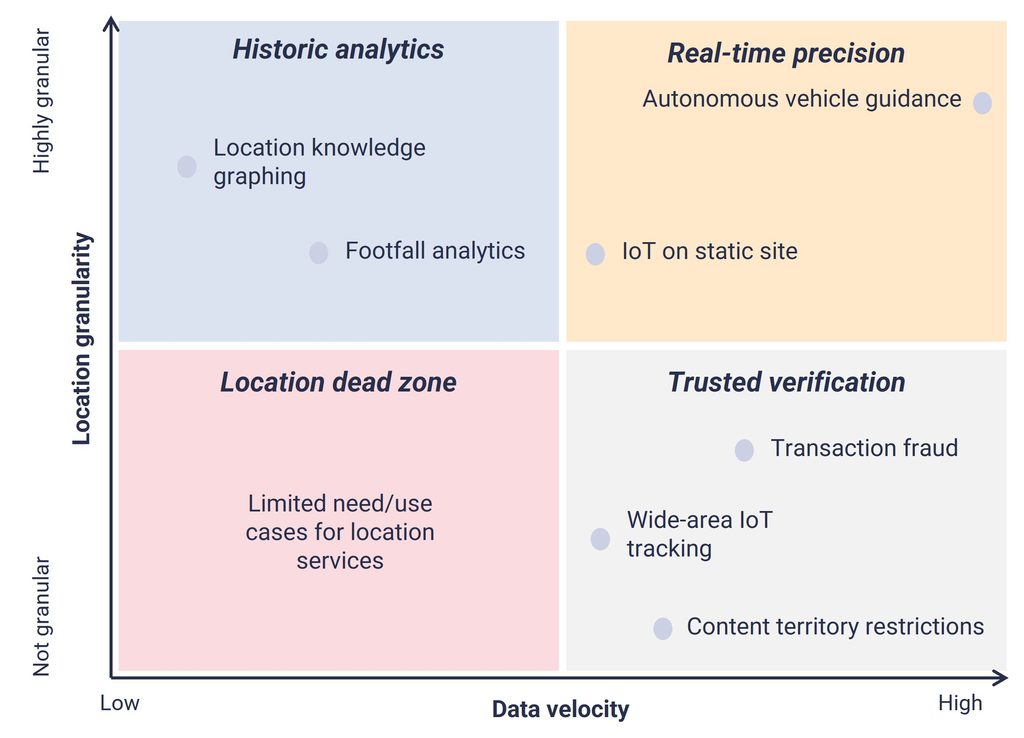
Source: STL Partners analysis
Telcos must find alternative criteria to compete with GPS and IP in their quadrants, aiming to be a source of trust. There are five main differentiating elements of telco data:
- Non-spoofable: Network-derived location cannot be faked on the device
- Consent capture and management: Taking on the burden to get end-user privacy consent and onboarding verified developers
- No app download: Works over the network, with nothing to install, reducing use case friction
- Indoor precision: Cell and small-cell data reach where GPS signals fail
- Bundling with other signals: Each location API combines with other network APIs or broader telco competencies to be a stickier proposition
In this report we explore the relative value of these five features for different use cases, which APIs telcos should commercialise first and next and which partners to work with.
