Significant hurdles remain to scaled migration of telco workloads to the public cloud, finds STL Partners
4 min read- Telcos have been steadily moving IT workloads, including business support systems (BSS), to the public cloud over the past decade
- However, there is greater hesitancy to the migration of network workloads to the public cloud
- Hyperscalers have established themselves as key go-to-market partners for telcos’ internal and external AI needs (including sovereign AI)
- Questions remain, however, whether major hyperscalers will be committed enough to continue investing in the development of telco-specific network solutions
LONDON – 2 October 2025 – Significant hurdles remain to scaled migration of telco workloads to hyperscale cloud platforms, despite hyperscaler investment in AI and hybrid cloud capabilities, STL Partners has found in its recent study, ‘Hyperscalers in the telco vertical: The future is hybrid’.
In its latest research, the company has analysed more than 300 telco-hyperscaler partnerships to assess the maturity levels of telcos’ workload migration to the public cloud and the positioning of four major cloud providers in the telco vertical: Amazon Web Services (AWS), Google Cloud, Oracle Cloud Infrastructure (OCI) and Huawei Cloud.
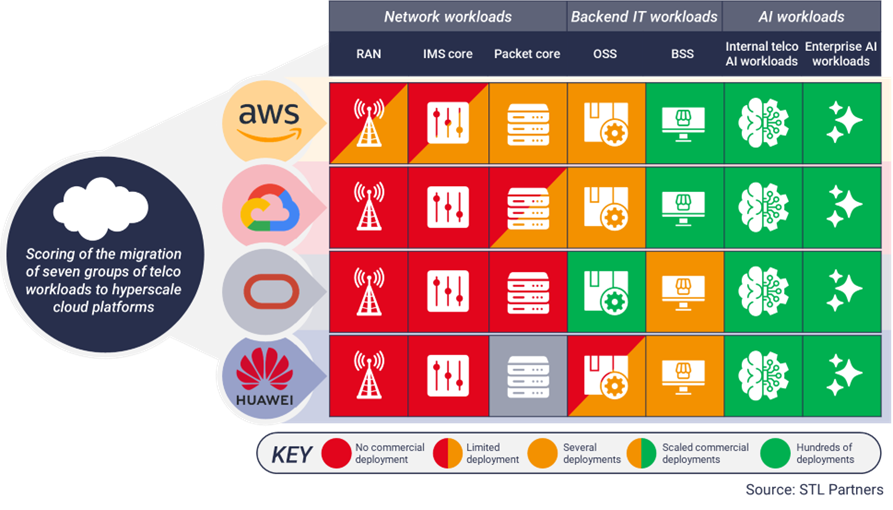
STL Partners has found that telcos have been tentative about migrating their network workloads, including elements of their operational support systems, packet core, IP Multimedia Subsystem (IMS) and radio access network (RAN) workloads.
“The migration of 5G core, IMS and RAN workloads to the public cloud remains nascent. To date, we have recorded 12 production deployments of 5G core workloads hosted on public cloud platforms, the majority of which have occurred at greenfield networks. The picture for RAN deployments is sparser: we know of only three instances of RAN workloads being hosted on hyperscale cloud platforms – one of which, at Boost Mobile, has now been decommissioned”, comments George Glanville, senior analyst at STL Partners and author of the research.
He adds that while this limited deployment must be framed in the wider context of scant deployment of open RAN and 5G standalone (SA), there are still “significant hurdles” to the deployment of these critical network workloads.
Some of the main challenges stem from questions around the technical and commercial performance of such models, and misalignment with telco investment cycles. Glanville emphasises further uncertainties around the commitment by virtual network function (VNF) and cloud-native network function (CNF) vendors to this model of deployment, as well as the drive by many governments towards digital autonomy, which has discouraged the use of non-sovereign infrastructure, including software assets, for network workloads.
According to the research house, an area that has proved more fruitful relates to AI workloads. Hyperscalers are key to telco AI ambitions – and as of September 2025, STL Partners has tracked 88 instances of telco-hyperscaler AI partnerships.
The latest study also suggests that hyperscalers are emerging as key go-to-market partners for telco sovereign cloud services, with STL Partners identifying 20 such collaborations, driven primarily by Huawei Cloud.
“Hyperscalers will form one of the several pillars supporting the hybrid cloud on which networks will operate. While for many workloads (e.g., BSS), the cloud in question will overwhelmingly be the public cloud (since it offers clear performance and cost advantages), more demanding network workloads (e.g., RAN) will need to remain on the private telco cloud for the foreseeable future”, Glanville explains.
Finally, STL Partners finds that the extent to which network functions are deployed on hyperscale platforms also depends on the cloud providers’ commitment to this relationship.
“There is substantial investment required on hyperscalers’ part to host demanding network workloads – and realising ROI is a slow, painful process. Microsoft Azure has shown this patience runs thin with the disbanding of Azure for Operators. Therefore, with the ongoing AI boom, there is a risk other hyperscalers divert away capital destined for their telco verticals”, the analyst concludes.
Assessment of public cloud migration by hyperscaler and workload type
Find out more insights from the report by downloading a summary here.
For media enquiries, click here to get in touch with our team.
STL Partners is a leading research and consulting company that focuses on the telecom industry and adjacent markets by helping telcos and their partners innovate, grow and stay ahead of the competition.
