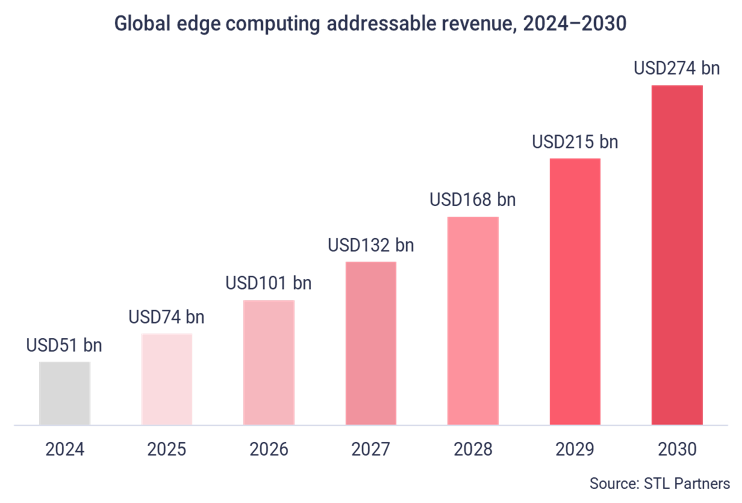
AI inferencing to drive demand for edge computing to reach USD274 billion by 2030
3 min read- Edge computing market to almost quadruple between 2025 and 2030.
- Media and entertainment will remain the largest market for edge computing, driven by content delivery.
- Manufacturing will be the second largest industry user of edge computing, led by automated guided vehicles and supported by growing demand for AI inferencing in computer vision applications such as quality inspection and asset monitoring.
LONDON – 10 June 2026 – The total addressable market for edge computing is forecast to grow from USD74 billion in 2025 to USD274 billion by 2030. This represents a compound annual growth rate of 30%, according to the latest market forecast from STL Partners, a leading telecoms and technology research and consulting company.
“The next five years will be critical for edge players seeking to turn edge computing from a promising technology into a mainstream part of AI infrastructure,” said Krsna Singh, Research Analyst at STL Partners. “As US hyperscalers continue to ramp up investment in AI model training, there is growing pressure to deliver returns through inferencing. Edge computing offers an opportunity here, acting as a sweet spot where compute cost, scalability and redundancy requirements make on-device deployment impractical, and where latency, data privacy or network cost considerations make cloud deployment less suitable.”
The forecast examines the evolving edge computing market across 21 use cases and 16 industry verticals. STL Partners assesses the revenue opportunity across the full value chain, split into six components: devices, connectivity, platforms, applications, integration services and support, and edge infrastructure.
STL Partners’ latest findings show that content delivery will account for 45% of the total value created at the edge. Computer vision applications, including safety and security, flow analysis and asset monitoring, will collectively account for a further 17%.
The media and entertainment industry will grab the major share of the edge computing revenue by 2030, representing 60% of the market, while manufacturing will be a distant second at 14% despite being an early adopter of on-premise edge computing.
The analysis also points to a major shift in the edge infrastructure mix. On-premise edge dominates today, accounting for 74% of total edge infrastructure revenue in 2025, but STL Partners expects this share to more than halve by 2030 as regional and network edge capture a larger proportion of the market. This shift will be driven almost entirely by the media and entertainment sector.
“Although the relative share of on-premise edge will decline over the next five years, it will remain the dominant platform for many AI applications, particularly computer vision, where models need to be deployed close to where data is generated,” added Singh. “For these applications, the need to reduce data backhaul costs and protect sensitive data makes on-premise edge the most attractive deployment model.”
STL Partners forecasts that the US and China will together account for nearly half of the global edge computing addressable market by 2030. Germany is expected to follow as the third-largest market.
Learn more about STL Partners’ Edge computing practice here.
Find out more insights from STL Partners’ forecast by downloading an extract here
For media enquiries, click here to get in touch with our team.
STL Partners is a leading research and consulting company that focuses on the telecom industry and adjacent markets by helping telcos and their partners innovate, grow and stay ahead of the competition.