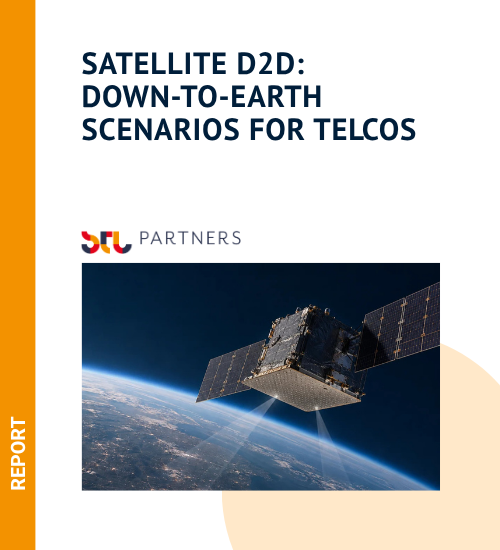
Satellite D2D: Down-to-Earth scenarios for telcos
£3,000.00 excl VAT
The amount of interest and hype about satellite/mobile integration is out-of-this-world. Telcos should escape the gravitational pull of simplistic substitution arguments and instead be concerned about strategic control points and customer ownership.
Description
Format: PDF file
Pages: 73
Author: Dean Bubley
Publication date: August 2026
Current market status
Satellite direct-to-device (D2D) has crossed an important threshold in 2026. It is concretely more than just a collection of basic emergency-messaging services, isolated demos of voice/video and speculative investor presentations.
There has been an ongoing stream of service announcements, new filings for additional proposed constellations, policy statements, new spectrum plans and company partnerships – as well as SpaceX’s IPO and trial Starship launches, various acquisitions and growing clamour over sovereignty.
The July edition of STL Partners’ Skywatch Tracker lists 214 telco-satco partnerships, including 37 that have launched D2D services commercially, mostly with Starlink, Skylo or one of the Chinese operators. Commercial data services with published subscription plans now exist across North America, Europe, China, Japan, Australasia, Ukraine and parts of Africa and the Pacific. Ordinary smartphones can now send text messages and use customised versions of selected apps. In the enterprise and B2B/IoT space, legacy proprietary satellite systems are starting to be upgraded to use 4G or 5G, with new business models and mainstream cloud integration becoming more viable. Several governments are testing D2D for public safety applications, as well as working with telcos and satcos to create a new resilience layer for both emergency services and the public.
Hard numbers are difficult to define and obtain, but perhaps 30–40 million personal users now have some form of D2D subscription, including those bundled into broader plans and those priced separately. This excludes many millions of others who have D2D features enabled automatically on their devices or by service providers, especially for emergency SOS or post-disaster messaging. This also excludes IoT endpoints.
D2D has not, however, crossed the much higher threshold of being a general substitute for terrestrial mobile networks, nor even demonstrated a credible roadmap to get there. Most services still require the user or device to be outdoors, with a clear view of the sky. They must generally accept lower capacity, slower handovers when terrestrial coverage ends, longer communications delays and occasional session failures.
There is a significant gulf between ‘a phone can send a message outdoors when there is no terrestrial signal’ and ‘all phones have 5G broadband everywhere, including indoors’. Despite that, various company presentations or putative total addressable market claims have jumped the gap, without waiting for the satellite constellations, spectrum, handsets or the physics of wireless propagation to catch up.
Statistics from crowdsourcing companies such as Ookla, as well as comments from individual operators such as T-Mobile US, have shown tiny aggregate data traffic volumes and usage disproportionately at weekends with good weather, in areas such as national parks or hiking trails. With exceptions of either conflict zones such as Ukraine, or disaster-recovery settings such as post-earthquake Venezuela, D2D is still mostly used by a thin sliver of outdoor enthusiasts or groups who live in truly remote regions yet have the financial resources for a suitable device and plan.
Unlike satellite broadband, which has become a significant player in the general rural connectivity market, D2D has yet to establish itself as a core part of the consumer mobile market. That probably reflects many urban users’ infrequent visits to deep-rural regions, broadly acceptable coverage on many roads, and an unwillingness to pay extra for service in network black spots they feel should be covered by their normal subscription anyway. Some will also have free emergency services access via Apple or other providers.
D2D is still a nascent market
Hard numbers are difficult to define and obtain, but perhaps 30–40 million personal users now have some form of D2D subscription, including those bundled into broader plans and those priced separately. This excludes many millions of others who have D2D features enabled automatically on their devices or by service providers, especially for emergency SOS or post-disaster messaging. This also excludes IoT endpoints.
D2D has not, however, crossed the much higher threshold of being a general substitute for terrestrial mobile networks, nor even demonstrated a credible roadmap to get there. Most services still require the user or device to be outdoors, with a clear view of the sky. They must generally accept lower capacity, slower handovers when terrestrial coverage ends, longer communications delays and occasional session failures.
There is a significant gulf between ‘a phone can send a message outdoors when there is no terrestrial signal’ and ‘all phones have 5G broadband everywhere, including indoors’. Despite that, various company presentations or putative total addressable market claims have jumped the gap, without waiting for the satellite constellations, spectrum, handsets or the physics of wireless propagation to catch up.
Statistics from crowdsourcing companies such as Ookla, as well as comments from individual operators such as T-Mobile US, have shown tiny aggregate data traffic volumes and usage disproportionately at weekends with good weather, in areas such as national parks or hiking trails. With exceptions of either conflict zones such as Ukraine, or disaster-recovery settings such as post-earthquake Venezuela, D2D is still mostly used by a thin sliver of outdoor enthusiasts or groups who live in truly remote regions yet have the financial resources for a suitable device and plan.
Unlike satellite broadband, which has become a significant player in the general rural connectivity market, D2D has yet to establish itself as a core part of the consumer mobile market. That probably reflects many urban users’ infrequent visits to deep-rural regions, broadly acceptable coverage on many roads, and an unwillingness to pay extra for service in network black spots they feel should be covered by their normal subscription anyway. Some will also have free emergency services access via Apple or other providers.
Recent developments
The D2D sector is highly dynamic, and this report represents both a snapshot at the end of July 2026 and scenarios and predictions with five- and ten-year horizons. It is highly probable that ongoing events, both specifically related to telco/satco relationships and more broadly in the space and satellite industry, will occur regularly.
Shifting narratives in 2026
In the first seven months of 2026, various changes have occurred in the discourse and debate around satellite D2D and its implications for telcos, especially incumbent MNOs. There has been much greater focus on satellite operators as a credible future strategic threat, with some cognitive dissonance as D2D is also seen as a viable new revenue source and differentiator for operators.
Some of the key narrative and anecdotal themes that STL Partners has observed, including from in-person events and conversations, include:
- D2D perception shifting from an emergency SOS feature to a prospective broadband platform. Companies such as SpaceX and AST are increasingly discussing 5G-like services with tens or hundreds of Mbps peak throughput rates. Some of this is picked up and amplified by retail investors and more hype-prone policymakers, as well as investment banks stretching to justify equity valuations.
- More ambiguous relationships with MNOs. Early D2D perception (excluding Apple/Globalstar) was mostly presented as clearly complementary, with operator-supplied spectrum, SIMs, customers and billing. Perception of SpaceX as a long-term risk, and maybe Amazon, has driven concern among MNOs, ‘maximalist’ investors and some policymakers, especially in Europe and Asia.
- Return of GEOs to the discussion, with Skylo, China Telecom’s Tiantong service and others looking at IoT use cases.
- MSS spectrum dynamics becoming more visible and contentious, and ownership/authorisations seen as an advantage and sovereignty cornerstone. Acquisitions of Iridium and Globalstar demonstrate this, as does the European Commission plan for 2027 pan-EU MSS licences. The Federal Communications Commission (FCC) is blurring boundaries between MSS/cellular use, while more people are realising why the WRC-27 conference could be critical for global D2D.
- D2D sovereignty is becoming a top-level concern, with multiple dimensions around spectrum, ownership, local jurisdiction and data residency, ground stations, supply chain of equipment, defence and public-safety access and positioning/navigation/timing dependencies.
- Early recognition that indoor coverage/access for D2D is going to be problematic, especially for maximalist visions.
- Slowly growing awareness of the complexities – and opportunities – for ground infrastructure for D2D, partly for sovereignty, but also for enterprise B2B and edge-cloud integration.
- Growing touch points between D2D and AI trends, although much remains in hype territory (e.g., space data centres).
Our insight covers the following key points:
- Executive Summary
- Introduction
- Spectrum, regulation, sovereignty and politics
- Technology enablers and obstacles
- Realistic D2D business models
- Enterprise D2D and IoT: Underestimated?
- Conclusions and scenarios: Implications for telcos
Technologies and industry terms referenced include: Amazon Leo, Digital sovereignty, direct-to-device, Emergency SOS messaging, Enterprise connectivity, eSIM, LEO constellations, MNO strategy, MSS spectrum, network resilience, Non-terrestrial networks, Rural coverage, satcos, Satellite D2D, Satellite IoT, Satellite spectrum, SpaceX, Starlink, Telco-satco partnerships, Universal service obligation, WRC-27